
What Is The Difference Between Visual Effects Like Blue Or Green Screen And CGI
Understanding The Tools Behind Modern Visual Effects
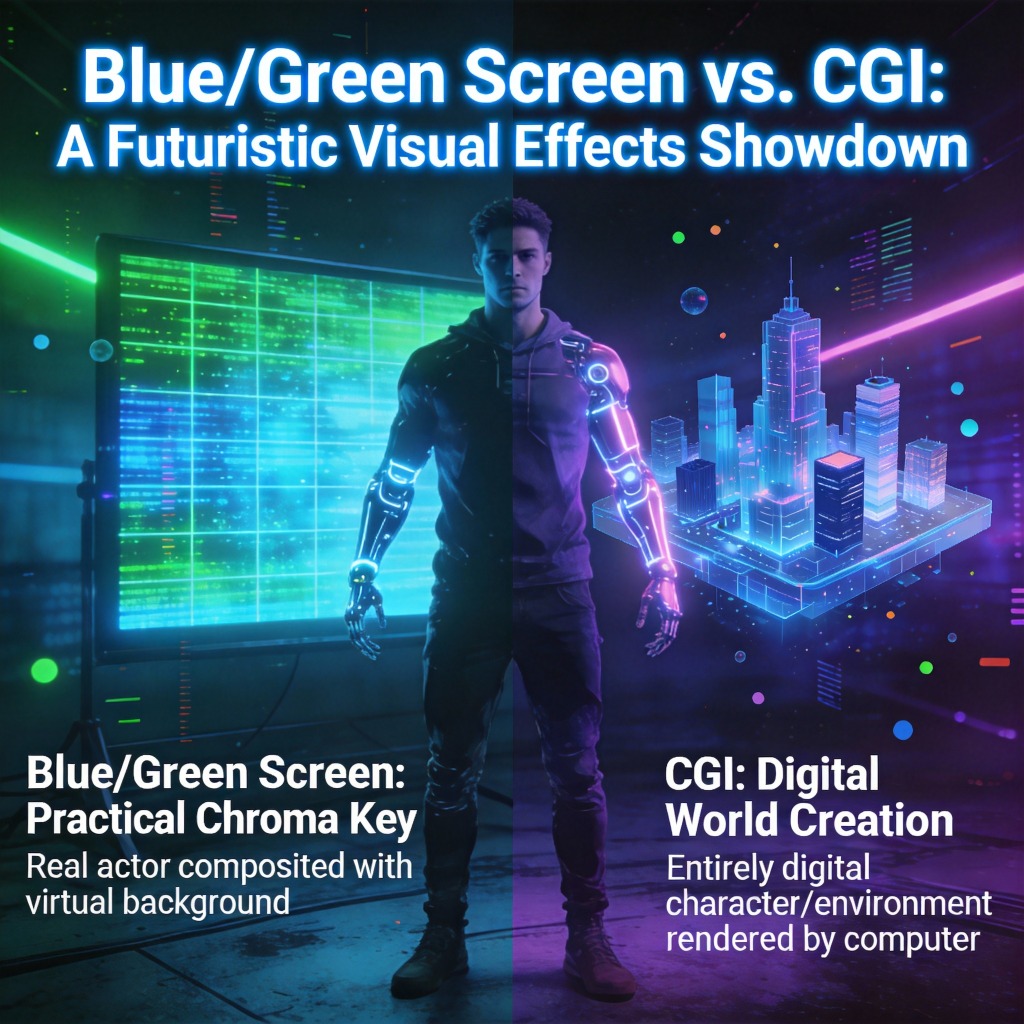
The world of visual effects has evolved so dramatically that audiences often forget how many different techniques are working together behind the scenes to create the images they see. Blue screen, green screen, and CGI each play a distinct role in shaping modern filmmaking, yet they are frequently grouped together as if they serve the same purpose. In reality, these tools differ in how they capture light, how they interact with costumes and environments, and how they influence the final look of a scene. Understanding these differences helps reveal the craftsmanship behind effects-driven storytelling and the decisions filmmakers make to achieve the right visual tone.
The Foundations Of Blue Screen Technology
Blue screen technology has been used for decades, long before digital filmmaking became the industry standard, and it remains a reliable method for compositing actors into new environments. The blue backdrop allows filmmakers to isolate subjects based on colour separation, which works especially well when costumes or props contain warm tones. Blue screens are often chosen for darker scenes because the colour produces less spill, meaning the blue light does not bounce onto the actors as aggressively. This creates cleaner edges and more natural blending when the background is replaced. The technique is valued for its stability and its long history of dependable results.
Table – Key Characteristics Of Blue Screen
| Feature | Description | Benefit |
|---|---|---|
| Colour Tone | Deep blue | Minimal spill |
| Best Use | Dark scenes | Cleaner edges |
| Interaction With Costumes | Avoids warm colours | Reduces blending issues |
| Lighting Needs | Higher exposure | Strong separation |
| Historical Use | Long-standing technique | Proven reliability |
The Rise Of Green Screen In Modern Filmmaking
Green screen became the dominant chroma key colour as digital cameras improved, because sensors capture green with greater sensitivity and clarity. This makes green screens ideal for bright, well-lit scenes where the goal is to achieve sharp outlines and fast keying. The vibrant green also contrasts strongly with human skin tones, reducing the risk of accidental removal during compositing. However, green screens can create more spill, especially in reflective costumes or shiny props, which requires careful lighting. Despite this, their efficiency and compatibility with digital workflows have made them the industry standard.
Points – Why Green Screen Became Popular
- Digital sensors capture green more efficiently.
- The colour contrasts well with skin tones.
- It allows faster keying in post-production.
- Ideal for bright, high-energy scenes.
- Works well with modern VFX pipelines.
The Purpose And Power Of CGI
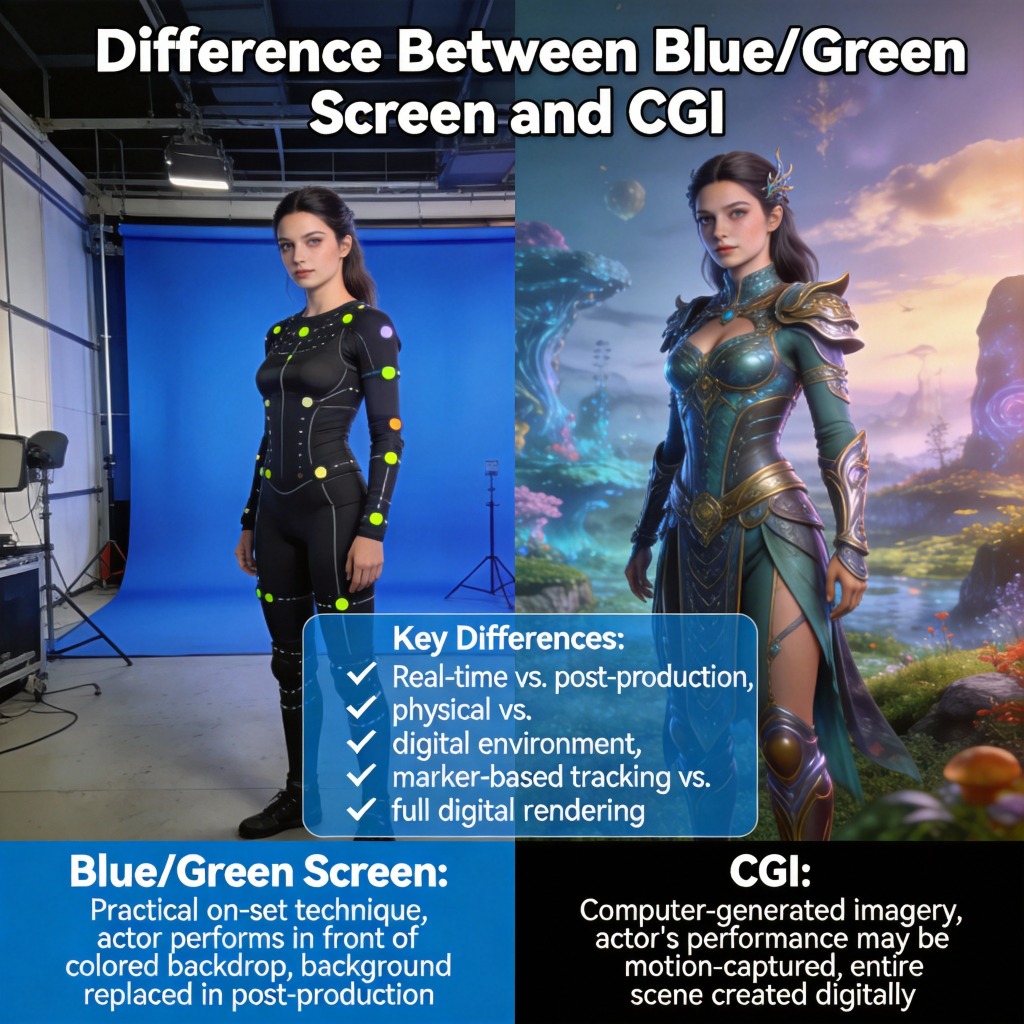
CGI, or computer-generated imagery, is not a backdrop but a digital creation that can replace or enhance any part of a scene. Unlike blue or green screens, CGI does not rely on physical colour separation; instead, it builds environments, characters, and effects entirely within a computer. This allows filmmakers to create worlds that would be impossible, unsafe, or too expensive to build physically. CGI can be subtle, such as removing wires or adding atmospheric elements, or it can be expansive, like constructing entire cities or creatures. Its flexibility makes it one of the most transformative tools in modern filmmaking.
Table – CGI Capabilities
| Capability | Description | Creative Impact |
|---|---|---|
| Digital Environments | Fully artificial worlds | Unlimited scale |
| Character Creation | Creatures or humans | Enhanced storytelling |
| Object Simulation | Vehicles, props, effects | Realistic motion |
| Atmospheric Effects | Smoke, fog, particles | Mood enhancement |
| Cleanup Work | Wire removal, fixes | Seamless visuals |
How Filmmakers Choose Between Blue And Green Screens
Choosing between blue and green screens depends on lighting, costume design, camera type, and the emotional tone of the scene. Blue screens are often used when the scene requires low light or when actors wear green clothing, while green screens dominate brightly lit productions. Filmmakers also consider how much colour spill they can manage, since green tends to reflect more aggressively. The decision is rarely arbitrary; it is a calculated choice that affects the entire visual workflow. Understanding these factors helps explain why both colours remain relevant.
Points – Factors That Influence Screen Choice
- Lighting conditions and exposure levels.
- Costume colours and reflective materials.
- Desired edge sharpness and spill control.
- Camera sensor sensitivity.
- Overall visual tone of the scene.
The Interaction Between Costumes And Chroma Keying
Costume design plays a crucial role in determining whether blue or green screens are used, because any colour that matches the backdrop will disappear during keying. This means actors cannot wear green on a green screen or blue on a blue screen unless the effect is intentional. Reflective materials also complicate the process, as they can pick up unwanted colour spill. Filmmakers often test costumes under production lighting before finalising their chroma key setup. This collaboration between departments ensures clean, believable composites.
Table – Costume Considerations
| Costume Type | Screen Issue | Best Solution |
|---|---|---|
| Green Clothing | Vanishes on green screen | Use blue screen |
| Blue Clothing | Vanishes on blue screen | Use green screen |
| Reflective Fabrics | Colour spill | Adjust lighting |
| Dark Outfits | Low contrast on blue | Increase exposure |
| Bright Outfits | High contrast on green | Cleaner keying |
The Lighting Challenges Of Blue And Green Screens
Lighting is one of the most critical elements in chroma key work, because uneven lighting can create shadows, hot spots, or colour inconsistencies that make keying difficult. Green screens require less light overall but are more prone to spill, while blue screens need stronger lighting to achieve proper separation. Filmmakers must balance the lighting on the actors with the lighting on the backdrop to avoid blending issues. This delicate balance often determines the success of the final composite. Proper lighting transforms a simple coloured sheet into a powerful visual effects tool.
Points – Lighting Priorities For Chroma Keying
- Even illumination across the backdrop.
- Minimal shadows behind the actors.
- Controlled spill on reflective surfaces.
- Balanced exposure between actors and screen.
- Consistent colour temperature.
The Role Of CGI In Enhancing Practical Effects
CGI is often used to enhance practical effects rather than replace them entirely, creating a hybrid approach that blends realism with digital flexibility. Filmmakers may build partial sets or props and extend them digitally to create larger environments. This method allows actors to interact with real objects while still benefiting from the limitless possibilities of CGI. The combination often produces more convincing results than relying solely on digital or practical techniques. Hybrid effects have become a hallmark of modern filmmaking.
Table – Hybrid Effects Examples
| Practical Element | CGI Enhancement | Result |
|---|---|---|
| Miniature Models | Digital extensions | Larger scale |
| Real Props | Added textures | Enhanced realism |
| Partial Sets | Full environment | Immersive world |
| Practical Explosions | Digital debris | Controlled chaos |
| Actor Performances | Digital creatures | Believable interaction |
The Differences In Post-Production Workflow
Blue screen, green screen, and CGI each require different post-production workflows, affecting how editors and VFX artists approach the material. Green screen footage typically keys faster due to its brightness and sensor compatibility, while blue screen footage may require more fine-tuning but produces smoother edges. CGI, on the other hand, involves building assets, animating them, and integrating them into the scene. These workflows often overlap but demand different skill sets. The complexity of post-production is one of the reasons visual effects teams are so specialised.
Points – Post-Production Considerations
- Keying difficulty varies by screen colour.
- CGI requires asset creation and animation.
- Compositing blends all elements together.
- Colour grading ensures visual consistency.
- Workflow depends on scene complexity.
The Historical Evolution Of Chroma Keying
Chroma keying began long before digital filmmaking, with early techniques relying on optical printers and chemical processes. Blue screens dominated early cinema because film stock responded better to blue light. As digital cameras emerged, green screens became more efficient due to sensor sensitivity. CGI later revolutionised the industry by removing the need for physical screens in many cases. This evolution reflects the constant push for more flexible and visually convincing effects.
Table – Timeline Of Key Developments
| Era | Technique | Impact |
|---|---|---|
| Early Cinema | Blue screen | First compositing methods |
| Film Era | Optical keying | Improved accuracy |
| Digital Cameras | Green screen | Faster workflows |
| Early CGI | Digital backgrounds | Expanded possibilities |
| Modern VFX | Full CGI worlds | Unlimited creativity |
The Creative Freedom Offered By CGI
CGI allows filmmakers to create scenes that defy physics, geography, and even imagination, giving them creative freedom unmatched by physical techniques. Entire worlds can be built from scratch, allowing stories to unfold in places that could never exist in reality. This freedom also enables filmmakers to experiment with visual styles, from hyper-realistic to stylised or abstract. CGI can support subtle storytelling or deliver massive spectacle. Its versatility makes it one of the most powerful artistic tools in cinema.
Points – Creative Advantages Of CGI
- Unlimited worldbuilding potential.
- Ability to create impossible creatures or environments.
- Flexible visual style options.
- Safe simulation of dangerous scenarios.
- Seamless integration with live action.
The Practical Benefits Of Blue And Green Screens
Despite the rise of CGI, blue and green screens remain essential because they allow filmmakers to capture real performances and integrate them into digital environments. This creates a more grounded feel, as actors interact with physical lighting and camera movement. Chroma keying also reduces the need for full CGI characters, which can be expensive and time-consuming. These screens offer a cost-effective way to blend reality with imagination. Their practicality ensures they remain part of the filmmaking toolkit.
Table – Practical Advantages
| Technique | Benefit | Use Case |
|---|---|---|
| Blue Screen | Low spill | Dark scenes |
| Green Screen | Fast keying | Bright scenes |
| CGI | Full control | Complex worlds |
| Hybrid | Best of both | Large productions |
| Practical Sets | Realism | Actor interaction |
The Challenges Of Matching CGI With Live Action
One of the biggest challenges in visual effects is ensuring that CGI elements blend seamlessly with live-action footage. Lighting, texture, motion, and perspective must all match perfectly to avoid breaking the illusion. Even small inconsistencies can make CGI feel artificial. This requires close collaboration between cinematographers, VFX artists, and directors. When done well, the result is indistinguishable from reality.
Points – Matching Challenges
- Lighting must match the real environment.
- Textures need realistic detail.
- Motion must follow physical rules.
- Shadows and reflections must align.
- Camera movement must be replicated digitally.
The Importance Of Colour Science In Chroma Keying
Colour science plays a crucial role in determining how blue and green screens interact with cameras and lighting. Different cameras interpret colours differently, which affects how cleanly the background can be removed. Filmmakers must consider colour temperature, sensor response, and exposure levels to achieve the best results. This scientific foundation supports the artistic goals of the scene. Without proper colour management, even the best screens can fail.
Table – Colour Science Factors
| Factor | Influence | Result |
|---|---|---|
| Sensor Sensitivity | Colour accuracy | Clean keying |
| Colour Temperature | Lighting balance | Natural tones |
| Exposure | Edge clarity | Reduced noise |
| Spill Control | Colour contamination | Cleaner composites |
| Contrast | Subject separation | Stronger visuals |

The Future Of Visual Effects Technology
The future of visual effects is moving toward real-time rendering, virtual production, and LED volume stages that blend CGI with physical performance in new ways. These technologies reduce the need for traditional blue and green screens by projecting digital environments directly onto massive LED walls. Actors can see the world around them, improving performance and lighting realism. CGI continues to evolve, becoming more detailed and efficient. The future promises even more seamless integration between digital and physical filmmaking.
Points – Emerging Trends
- Real-time rendering engines.
- LED volume stages.
- AI-assisted compositing.
- More efficient CGI pipelines.
- Hybrid production environments.
Conclusion
Blue screen, green screen, and CGI each play a distinct role in shaping the visual language of modern filmmaking, and understanding their differences reveals the depth of craftsmanship behind every effect. Blue screens offer stability and low spill, green screens provide speed and clarity, and CGI opens the door to limitless creative possibilities. Filmmakers choose between these tools based on lighting, costumes, tone, and the emotional needs of the scene. When used together, they create immersive worlds that blend reality with imagination in ways that continue to evolve. The artistry behind these techniques is a reminder that visual effects are not just technical solutions but creative expressions in their own right.
Join The Discussion
Do you prefer the grounded feel of practical chroma key work, or do you think CGI offers a more exciting future for filmmaking?
#VisualEffectsCraft #BlueScreenVsGreenScreen #CGIInnovation #FilmmakingTools #CinematicTechnology #BehindTheScenesMagic