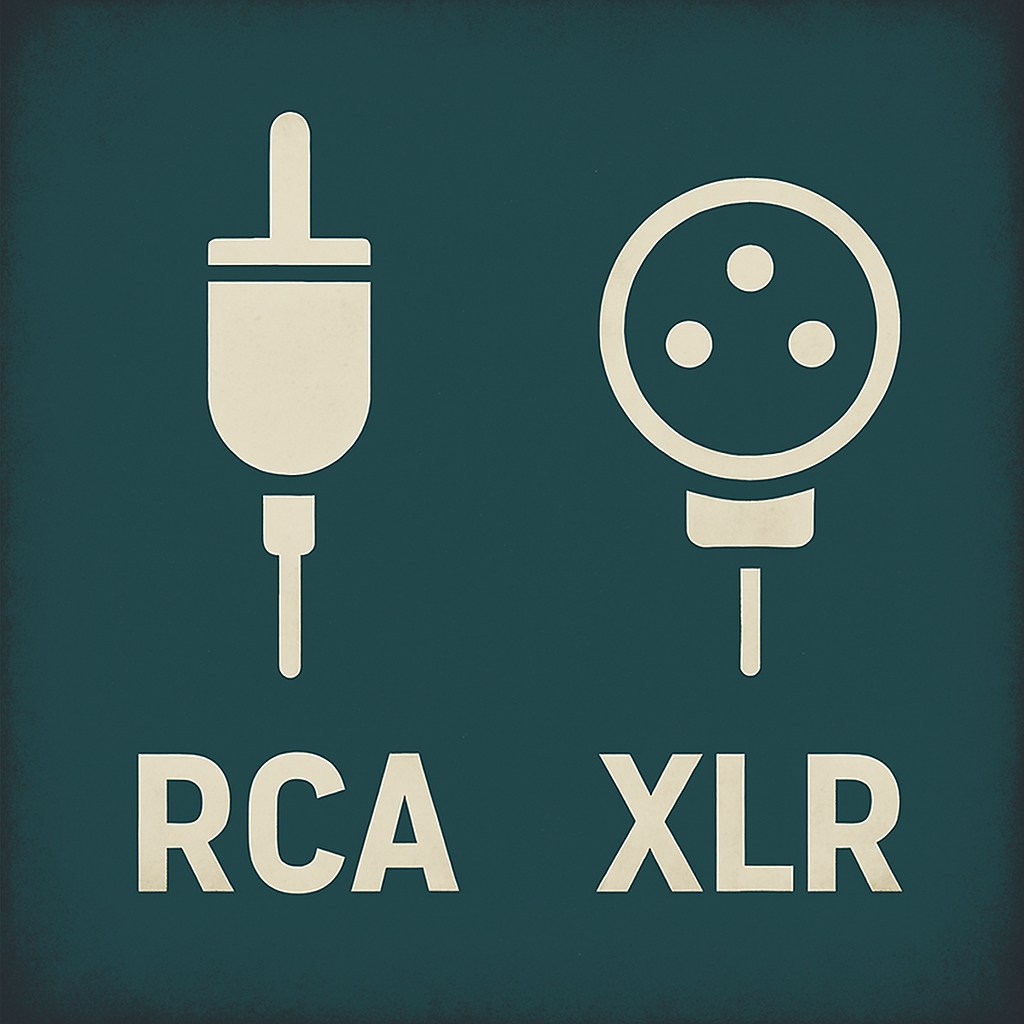
The Difference Between XLR and RCA cables For Hifi
XLR and RCA cables – Understanding Audio Connectivity
High fidelity audio systems depend on the quality of their connections, and cables are the lifelines that carry signals between components. XLR and RCA cables are two of the most common types, yet they serve different purposes and are engineered with distinct philosophies. XLR cables are designed for balanced audio transmission, which means they can reject noise and interference effectively, making them ideal for professional environments such as recording studios and live sound reinforcement.
RCA cables, on the other hand, are unbalanced and simpler in design, which makes them more affordable and widely compatible with consumer HiFi equipment. The differences between these two cable types are not just technical but also practical, influencing how they are used, the environments they thrive in, and the sound quality they deliver.

Historical Background – Origins Of XLR And RCA
The origins of XLR and RCA cables reveal much about their intended roles in audio technology. XLR cables were developed in the mid-20th century by Cannon Electric, specifically for professional broadcasting and recording applications. Their three-pin balanced design quickly became the standard in studios and live sound setups, offering durability and superior noise rejection. RCA cables, created earlier in the 1940s by the Radio Corporation of America, were designed for consumer electronics such as phonographs, radios, and later televisions.
Their two-conductor design was simple, inexpensive, and easy to use, which made them ideal for mass-market adoption. Over time, RCA connectors became ubiquitous in home audio systems, while XLR remained dominant in professional environments. This divergence in history explains why RCA is still common in domestic HiFi setups, while XLR is synonymous with professional-grade reliability.
Sound Quality – Perceived Differences
Sound quality is one of the most frequently debated aspects when comparing XLR and RCA cables, and while both are capable of transmitting high-fidelity audio, the way they handle interference and signal integrity can influence the listening experience. XLR cables, with their balanced design, are engineered to reject noise and maintain clarity even in environments filled with electromagnetic interference, which is why they are trusted in professional studios and live sound applications. RCA cables, being unbalanced, are more vulnerable to hums, buzzes, and subtle distortions, particularly when used in longer runs or in systems with multiple interconnected devices.
In short, RCA can sound identical to XLR in short, clean connections, but differences become noticeable in complex or noisy setups. Audiophiles sometimes describe RCA as offering a slightly warmer or more characterful sound due to its simplicity, while professionals emphasize the precision and transparency of XLR connections. The perception of sound quality therefore depends not only on the cables themselves but also on the environment, equipment quality, and the listener’s expectations.
- XLR cables deliver cleaner audio in challenging environments
- RCA cables can introduce hum or noise in complex systems
- Balanced design ensures clarity and precision in XLR setups
- Unbalanced design makes RCA more vulnerable to interference
- Short RCA runs can sound identical to XLR connections
- Longer RCA runs often degrade signal quality noticeably
- Audiophiles sometimes prefer RCA for perceived warmth
- Professionals rely on XLR for accuracy and reliability
- Environmental factors strongly influence perceived differences
- Listener expectations shape how sound quality is judged
Construction Differences – Cable Design And Engineering
The physical construction of XLR and RCA cables is one of the most significant differences between them. XLR cables use three conductors: a positive, a negative, and a ground. This balanced design allows them to cancel out interference by transmitting mirror-image signals that recombine at the destination. RCA cables use only two conductors: a signal and a ground. This unbalanced design makes them more vulnerable to interference, especially over long distances. XLR cables also feature robust shielding and connectors with a locking mechanism, ensuring durability and secure connections. RCA cables, while easier to plug and unplug, rely on a push-fit design that can loosen over time. These engineering differences directly affect performance, durability, and suitability for different environments.
| Feature | XLR Cable | RCA Cable |
|---|---|---|
| Conductors | 3 (balanced) | 2 (unbalanced) |
| Shielding | Heavy, professional-grade | Light, consumer-grade |
| Connector Type | Locking mechanism | Push-fit |
| Durability | High | Moderate |
| Typical Use | Professional audio | Consumer HiFi |
Signal Transmission – Balanced Versus Unbalanced
Signal transmission is where the most critical differences between XLR and RCA cables emerge. Balanced transmission, used in XLR cables, involves sending two identical signals with opposite polarity. When these signals reach the destination, any interference picked up along the way is cancelled out, resulting in a clean audio signal. This design allows XLR cables to carry signals over long distances without degradation, which is essential in professional environments such as recording studios and live concerts.
RCA cables, being unbalanced, transmit a single signal with a ground reference. This makes them more susceptible to noise and interference, especially in environments with strong electromagnetic fields. For short distances in home setups, RCA cables perform adequately, but they cannot match the reliability of XLR in complex or noisy environments.
- Balanced signals cancel interference effectively
- Unbalanced signals are more vulnerable to noise
- XLR supports long cable runs without loss
- RCA is suitable for short connections
- Professional studios prefer XLR for reliability
- RCA remains common in consumer HiFi systems
- Balanced design improves clarity in complex setups
- Unbalanced design is simpler and cheaper
- XLR reduces hum from electrical interference
- RCA can introduce distortion in long runs
Practical Applications – Where Each Cable Excels
The environments in which XLR and RCA cables are used highlight their strengths and limitations. XLR cables are indispensable in professional recording studios, live sound reinforcement, and broadcasting, where reliability and noise rejection are critical. Their ability to maintain signal integrity over long distances makes them ideal for complex setups involving multiple devices. RCA cables, by contrast, are the backbone of consumer HiFi systems, connecting CD players, turntables, and amplifiers in home environments. Their simplicity and affordability make them accessible to everyday users, even though they are less suited to demanding professional contexts. Understanding these applications helps audiophiles and technicians choose the right cable for their specific needs.
| Application | XLR Cable | RCA Cable |
|---|---|---|
| Recording Studios | Preferred for balanced signals | Rarely used |
| Live Sound | Essential for reliability | Not suitable |
| Home HiFi | Optional but growing | Standard choice |
| Long Cable Runs | Excellent performance | Poor performance |
| Consumer Electronics | Limited compatibility | Universal adoption |
Durability And Reliability – Physical Strength
Durability is a defining characteristic of XLR cables, which are engineered for rugged use. Their connectors are typically made of metal, with a locking mechanism that prevents accidental disconnection. This makes them ideal for touring musicians, live sound engineers, and studio professionals who need cables that can withstand constant handling. RCA cables, while adequate for home use, are more fragile. Their push-fit connectors can loosen over time, and the lighter shielding makes them more vulnerable to physical damage. For stationary consumer setups, RCA cables are sufficient, but they cannot match the resilience of XLR in demanding environments.
- XLR connectors resist wear and tear in professional use
- RCA connectors can degrade with repeated plugging and unplugging
- Locking design prevents accidental disconnection during live performances
- Push-fit design is easier but less secure in complex setups
- Professional gear demands XLR durability for reliability
- RCA suits stationary consumer setups where cables remain untouched
- XLR cables withstand heavy use in touring and stage environments
- RCA cables are prone to bending and connector damage
- XLR shielding protects against interference in noisy environments
- RCA shielding is lighter and less effective in complex systems
Compatibility – Device Support
Compatibility is another area where XLR and RCA cables differ significantly. XLR cables are designed for professional equipment such as microphones, mixers, and amplifiers, making them less common in consumer electronics. RCA cables, however, are universally supported across home audio devices, including CD players, turntables, and televisions. This widespread compatibility explains why RCA remains the default choice for most HiFi systems, even though XLR offers superior performance in professional contexts.
| Device Type | XLR Support | RCA Support |
|---|---|---|
| Microphones | Yes | No |
| Amplifiers | Yes | Yes |
| Mixers | Yes | Limited |
| CD Players | Rare | Yes |
| Turntables | Rare | Yes |
Cost Considerations – Price And Value
Cost is often a deciding factor when choosing between XLR and RCA cables. XLR cables are generally more expensive due to their construction, materials, and professional-grade design. RCA cables are cheaper and widely available, making them accessible to most consumers. The cost difference reflects durability and performance rather than inherent sound quality. For audiophiles seeking reliability and long-term value, XLR may justify the higher price. For everyday users, RCA remains a cost-effective solution that balances affordability with adequate performance.
- XLR cables cost more due to professional-grade construction
- RCA cables are cheaper and widely available in consumer markets
- Price differences reflect durability and shielding quality
- Sound quality can be similar in short runs despite cost differences
- XLR offers long-term value for professional setups
- RCA provides affordability for everyday HiFi use
- Higher cost of XLR is justified in complex environments
- RCA remains practical for budget-conscious consumers
- Professional studios invest in XLR for reliability
- Home users rely on RCA for accessibility
Noise Rejection – Shielding And Performance
Noise rejection is one of the most critical differences between XLR and RCA cables. XLR cables cancel interference through their balanced design, making them ideal for environments with strong electromagnetic fields. RCA cables rely solely on shielding, which is less effective in complex setups. Balanced transmission reduces hum from power lines and prevents ground loops, ensuring stable performance. RCA cables, while sufficient in quiet home environments, can introduce noise in multi-device setups. This makes XLR the preferred choice for professionals who require clean, interference-free audio.
| Noise Factor | XLR Cable | RCA Cable |
|---|---|---|
| Interference Cancellation | Excellent | Limited |
| Ground Loop Resistance | Strong | Weak |
| Shielding Quality | Heavy-duty | Variable |
| Performance In Noisy Environments | Stable | Vulnerable |
Technical Specifications – Voltage And Impedance
Technical specifications further distinguish XLR and RCA cables. XLR cables handle higher voltages and are designed with an impedance of 110 ohms, optimized for balanced audio transmission. RCA cables operate at lower voltages with an impedance of 75 ohms, suitable for unbalanced signals. These differences affect how each cable interacts with audio equipment, influencing performance in professional versus consumer contexts.
- XLR cables handle higher voltage levels safely
- RCA cables operate at lower voltage ranges
- XLR impedance is 110 ohms for balanced transmission
- RCA impedance is 75 ohms for unbalanced signals
- Technical design reflects professional versus consumer priorities
- Voltage handling ensures stability in complex setups
- RCA specifications suit simple home systems
- XLR specifications optimize clarity in professional environments
- Impedance differences affect signal integrity
- Professional gear is designed around XLR standards
Consumer Versus Professional Use – Market Differences
The distinction between consumer and professional use is central to understanding why XLR and RCA cables coexist in the audio world. XLR cables dominate professional markets because they are engineered for reliability, durability, and noise rejection. Recording studios, live sound engineers, and broadcasters rely on XLR connections to maintain consistent audio quality under demanding conditions.
RCA cables, however, remain the standard in consumer electronics due to their affordability and universal compatibility. Home HiFi systems, televisions, and gaming consoles often use RCA because it is simple and cost-effective. Audiophiles sometimes experiment with XLR in home setups, but widespread adoption is limited by the lack of XLR inputs on consumer devices. This division reflects how engineering priorities shape market adoption, with XLR serving professionals and RCA serving everyday users.
| Market Segment | XLR Cable | RCA Cable |
|---|---|---|
| Professional Studios | Standard | Rare |
| Live Sound | Essential | Not used |
| Broadcasting | Dominant | Minimal |
| Home HiFi | Optional | Standard |
| Consumer Electronics | Limited | Universal |

Installation And Setup – Ease Of Use
Installation and setup highlight the practical differences between XLR and RCA cables. RCA cables are straightforward, with a simple push-fit design that makes them easy for beginners to use. Their smaller connectors are lightweight and intuitive, requiring no special alignment. XLR cables, by contrast, use a locking mechanism that ensures secure connections but requires more careful handling. While this adds complexity, it also prevents accidental disconnection, which is critical in professional environments. RCA suits compact home systems where simplicity is valued, while XLR suits complex studio setups where stability is essential.
- RCA cables are simple to connect without technical knowledge
- XLR cables require alignment and locking for secure use
- RCA connectors are smaller and lighter for compact systems
- XLR connectors are bulkier but stronger for professional setups
- RCA installation is faster and easier for beginners
- XLR installation ensures stability in demanding environments
- RCA suits home users who value convenience
- XLR suits professionals who value reliability
- RCA connectors can loosen over time with repeated use
- XLR connectors remain secure even under heavy handling
Future Trends – Cable Evolution
Future trends in audio connectivity suggest that both XLR and RCA will continue to serve distinct roles. XLR cables are expected to maintain dominance in professional audio, where balanced transmission and durability remain essential. RCA cables will likely remain stable in consumer markets, supported by their affordability and compatibility with legacy devices. Digital integration is expanding, with HDMI and USB increasingly used in consumer electronics, but RCA continues to serve as a bridge for older equipment. XLR’s longevity is assured by its professional adoption, while RCA’s relevance persists due to its widespread presence in home systems. The evolution of audio technology may introduce new standards, but XLR and RCA remain foundational.
| Trend | XLR | RCA |
|---|---|---|
| Professional Audio | Continued dominance | Declining presence |
| Consumer HiFi | Growing adoption | Stable use |
| Digital Integration | Limited role | Expanding role |
| Longevity | High | Moderate |
Conclusion – Choosing The Right Cable
Choosing between XLR and RCA cables depends entirely on context. For professional environments, XLR cables provide unmatched reliability, noise rejection, and durability, making them indispensable in studios, live sound, and broadcasting. For consumer HiFi systems, RCA cables remain practical, affordable, and widely compatible, ensuring accessibility for everyday users. While sound quality can be similar in short runs, XLR’s balanced design ensures superior performance in complex or noisy environments. RCA continues to thrive in home systems due to its simplicity and cost-effectiveness. Understanding these differences allows audiophiles and technicians to make informed decisions that balance cost, performance, and application.
Join The Discussion
Do you rely on RCA cables for your home HiFi setup, or have you experimented with XLR for professional-grade clarity?
#AudioCables #HiFi #XLR #RCA #SoundQuality #Audiophile #BalancedAudio #UnbalancedAudio #HomeTheatre #MusicTech